
Hi and welcome back to another week! Honestly, I’ve been so caught up with work this week I almost forgot to update you guys on what I have been up to. This week was a workload and to be honest, I’m very proud of that because I’ve kept a gazelle intensity with working this week and I hope that this energy lasts till the end of 2020.
I have been working on my lit review and it’s coming along nicely. There are so many books and journals to read out there that are interesting reads but it’s getting more difficult to weed out the best resources for my lit review. I’ve read some more work from English professor and ESL program Director Vivian Zamel about her theories and pedagogy on ESL writing. The articles were very insightful and edifying however, I did not believe that they were fit for my research. Nevertheless, I read more articles from other ESL professors and teachers like Margo DelliCarpini and Ruth Spack which I will share with you below.
Margo DelliCarpini earned her Ph.D. in Linguistics at Stony Brook University and is an assistant professor of TESOL at Lehman College, CUNY, where she works with ESOL certification candidates. She has taught ESL at the elementary, secondary, adult, and higher education levels.
As a newly certified teacher, Margo was hired to teach ESL high school students in the upcoming fall. She was excited to create interesting lessons and activities for her students. However, she was shocked on the first day of school when her students were not as she expected. She found that the materials she prepared would not help her teach ESL students in an effective way. After just that one day she was ready to quit but she didn’t. She states,
I didn’t quit. I went back to the drawing board, revised, researched, consulted teachers from other disciplines, and sought out appropriate material. Eventually, I was able to teach these students how to read, how to write, how to get the main idea from a passage, how to respond to literature by making connections to their own lives, and how to believe in themselves. It didn’t happen overnight, and the students and I learned together. (DelliCarpini, pg.98)
Margo was proud of her success as an ESL teacher; she attributed this success to four skills, English, listening, speaking, and reading. She states that ESL teachers should integrate these four skills in English as a way to accomplish communication goals. In the classroom, she taught grammar-based tasks, practiced oral language skills, and taught students to read a range of information from street signs to product labels and literature. Her approach to teaching ESL students was personable and relatable and that’s what made her time teaching ESL effective. In the article, she writes, “Success is more likely when the content is meaningful and relevant to the learner, which leads to enhanced motivation, another necessary component in successful second language acquisition’ (99). I loved this article because it described both the challenges and joys of being an ESL teacher. Margo did not go into this career having all the resources but learned through the students and other dedicated staff what is most effective for new language learners and that was to make a connection. What she needed to succeed in the classroom was for her students to be supported in every way possible. From home to school life all of these factors had to be connected. I like the points Margo made in her article and also the facts that she mentioned were insightful and truthful.
Another aspect that I really enjoyed about her article is that there were very important statements that stood out to me.
As our ELL population continues to increase, the only way to move forward is to equip teachers with the knowledge and skills they need to create classes that truly address the needs of diverse learners. (101)
ESL classrooms are enriching environments and ESL teachers and students had the freedom to select subjects that were interesting to the students. Now ESL students are no longer exempt from content assessments so this makes it harder for teachers to have the freedom to teach them to learn but force them to learn subjects and skills needed to pass state test. (103)
____________________________________________________________________________________________________________
Reading List cont.
There was also a lot of articles that I read from linguistic professor and author Ruth Spack. She has done extensive research on the ESL learner community specifically the Indian American population. Here are a few short articles that I read from her career as an ESL professor. The last one I choose to include in my lit review.
- Spack, Ruth and Vivian Zamel, ed. Language Lessons: Stories for Teaching and Learning English. Ann Arbor: University of Michigan Press, 2008.
- Zamel, Vivian and Ruth Spack. “Teaching Multilingual Learners Across the Curriculum: Beyond the ESOL Classroom and Back Again.” Journal of Basic Writing 25. 2 (2006): 126-152.
- Spack, Ruth. Teaching Writing for ESL Students. 4th ed. Upper Saddle River: Pearson, 2005.
- Spack, Ruth. “Teaching Across Cultures.” Rev. of Listening to the World; Cultural Issues in Academic Writing; Decoding ESL: International Students in American Colleges, by Helen Fox; Amy Tucker. College English vol. 58 (1996): 592-597.
This article was originally written in 1988 it was updated and revised in the year 2001. Both citations are included below.
Spack, Ruth. “Initiating ESL Students into the Academic Discourse Community: How Far Should We Go?” TESOL Quarterly, vol. 22, no. 1, 1988, pp. 29–51.
Spack, Ruth. “Initiating ESL Students into the Academic Discourse Community: How Far Should We Go?.” Landmark Essays on ESL Writing. Ed. Tony Silva and Paul Kei Matsuda. New York: Routledge, 2001. 91-108.
In this article writing researchers and teachers get together to study the ways ESL writers write. These writing researchers create a goal for writing programs to create better academic writers and develop approaches to teaching writing. This plan has emerged in response to criticism of previous writing programs geared towards helping ESL students become better academic writers.
In the article, Spack argues that when it comes to ESL writers there are two major problems. “The first is that there is a large gap between what students bring to the academic community and what the academic community expects of them” (pg. 30). These two problems create a wide gap in the academic field for ESL students because “even if ESL students are highly literate in their native language…the students lack of linguistic and cultural knowledge can stand in the way of academic success” (30). Even so, Spack asserts that “it is clearly the obligation of the ESL writing teacher, whether teaching basic writers or highly literate students to find a way to narrow the gap” (30). She provides two ways that ESL teachers can solve this problem. One way (as suggested by researchers) is to create writing programs to teach ESL writing as a discipline, the second is to state clearly what academic writing is and its goal. This problem and solution she discusses in her article is inspiring because there is indeed a gap between what teachers expect from ESL students and what the resources that are offered. I want to state in my research that ESL writing programs is one way that teachers can help close the gap and help ESL students succeed.
Stating the Facts
I mentioned before that moving forward I wanted to dive into more statistical facts and numbers about ESL learners. Specifically, I want to know the percentages of ESL learners in the state of New Jersey, the resources offered, and how our state plans to move forward with immigrant student populations. I have completed a great deal of qualitative research with the case studies. This part of my study is where I get into quantitative research with data and facts. The data draw on a variety of reliable sources from the US Census, New Jersey state performance reports, newly collected statistical information, and information gathered in a series of surveys completed by literacy committees.
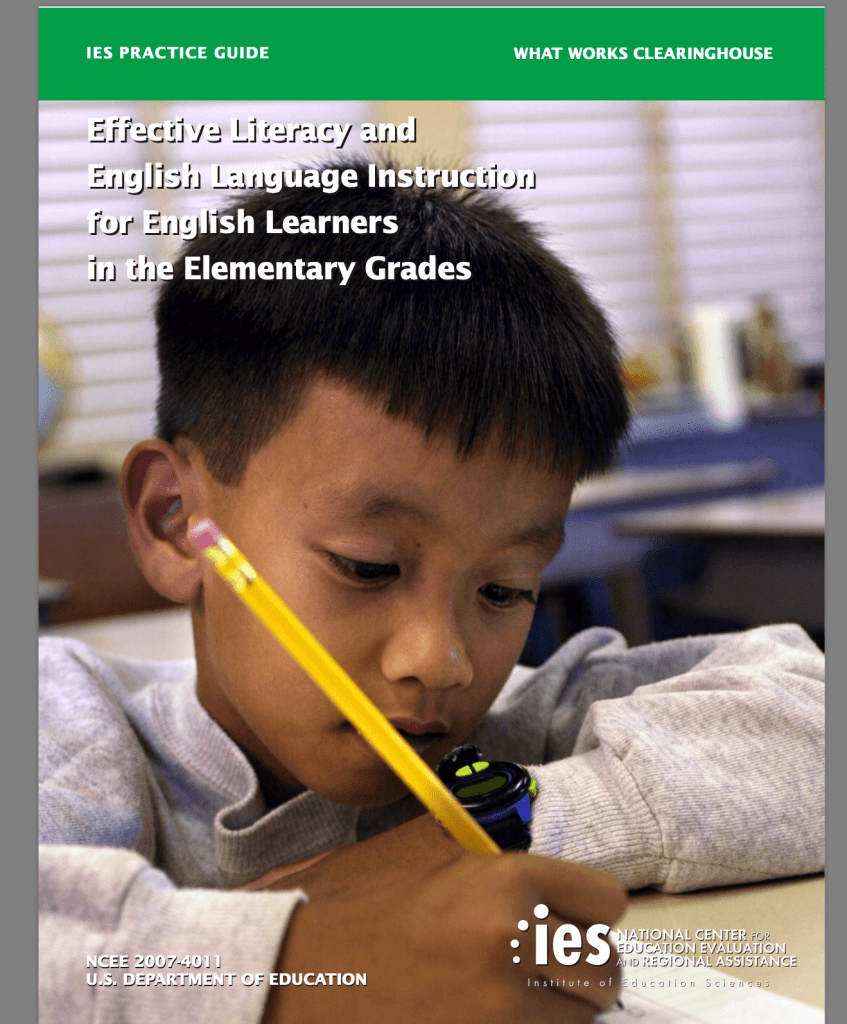
The National center for Education Evaluation and Regional Assistance provides effective and proven learning strategies that work for ESL students. This educational report equips teachers and districts with the tools needed for proper assessment data and other resources for advancing ESL learning. Please take a look at the table of contents and other highlights below for more information. If you would like to have access to this information please clicking the image above.


There was a lot of reading and gathering information which I am still completing this week. By next week I plan to get more data and share some highlighted information with you all. Until next time. Thank you for stopping by!


